
Structure the Logic Hidden in
Your dispatch logic lives in in your dispatchers' heads and the manual layer no software touches. We extract it and turn it into agents inside your system.
Your software automates the standard 80%, while 20% stay hidden and costs you money
Staff Growth
More deliveries mean more dispatchers — hiring, training, offshore coverage, shift gaps. The cost scales with order count, not with exceptions that actually need humans.
Volatile Margin
Dispatchers adjust prices, add driver bonuses, and reassign orders without logging or clear visibility. Every shift introduces variance that doesn't show up until it hits the P&L.
Locked-In Logic
Key dispatch logic lives in undocumented code, and in the heads of 1–2 people no one can afford to lose. When they're out, the operation slows. When they leave, it stalls.
Extract what your operation already knows
Your dispatch logic already exists in your operational data, dispatchers' decisions, chats, сalls, and code. We surface it, formalize it with your team, and deploy it as agents inside your infrastructure, on top of whatever stack you run.
Exception-Based Dispatching
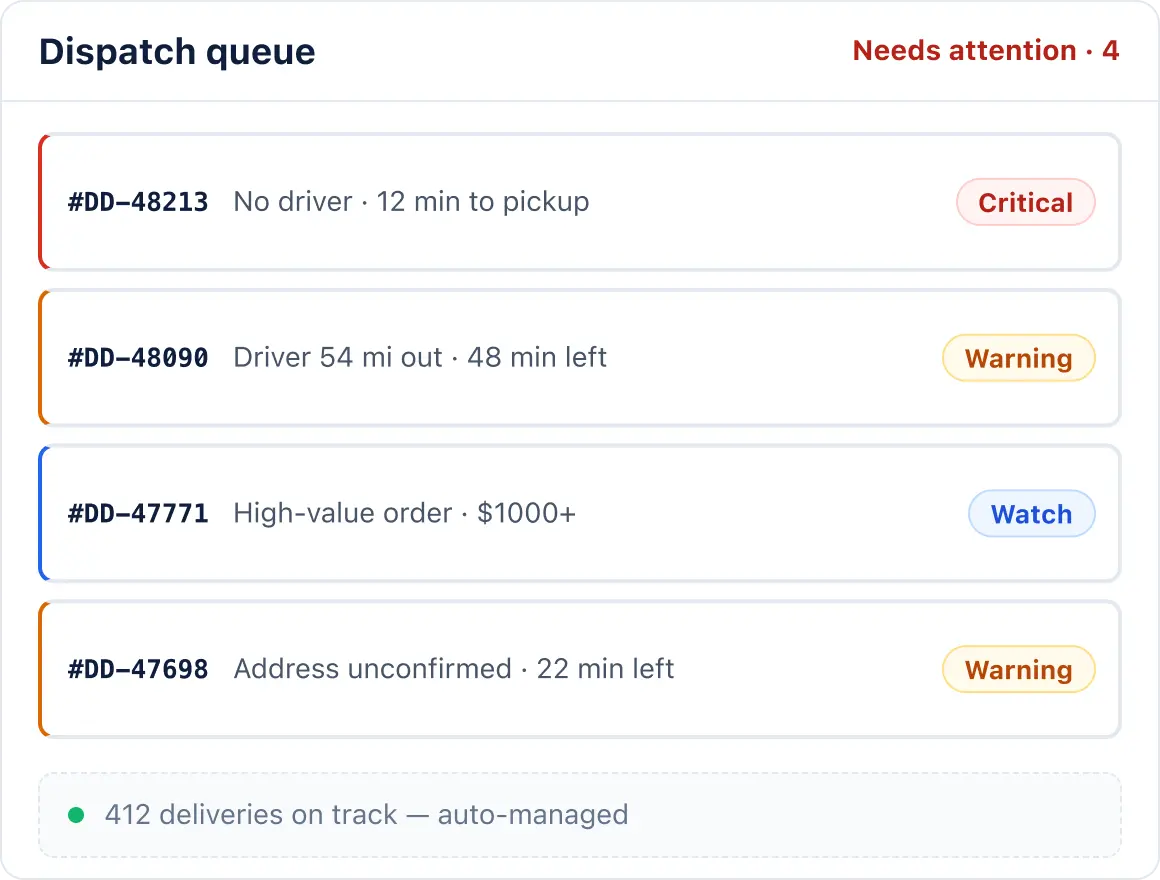
Your team sees only what actually needs them.
Dispatchers stop monitoring all orders and focus only on those flagged for attention. Every alert is pre-filtered so only meaningful deviations surface.
Proactive SLA Monitoring
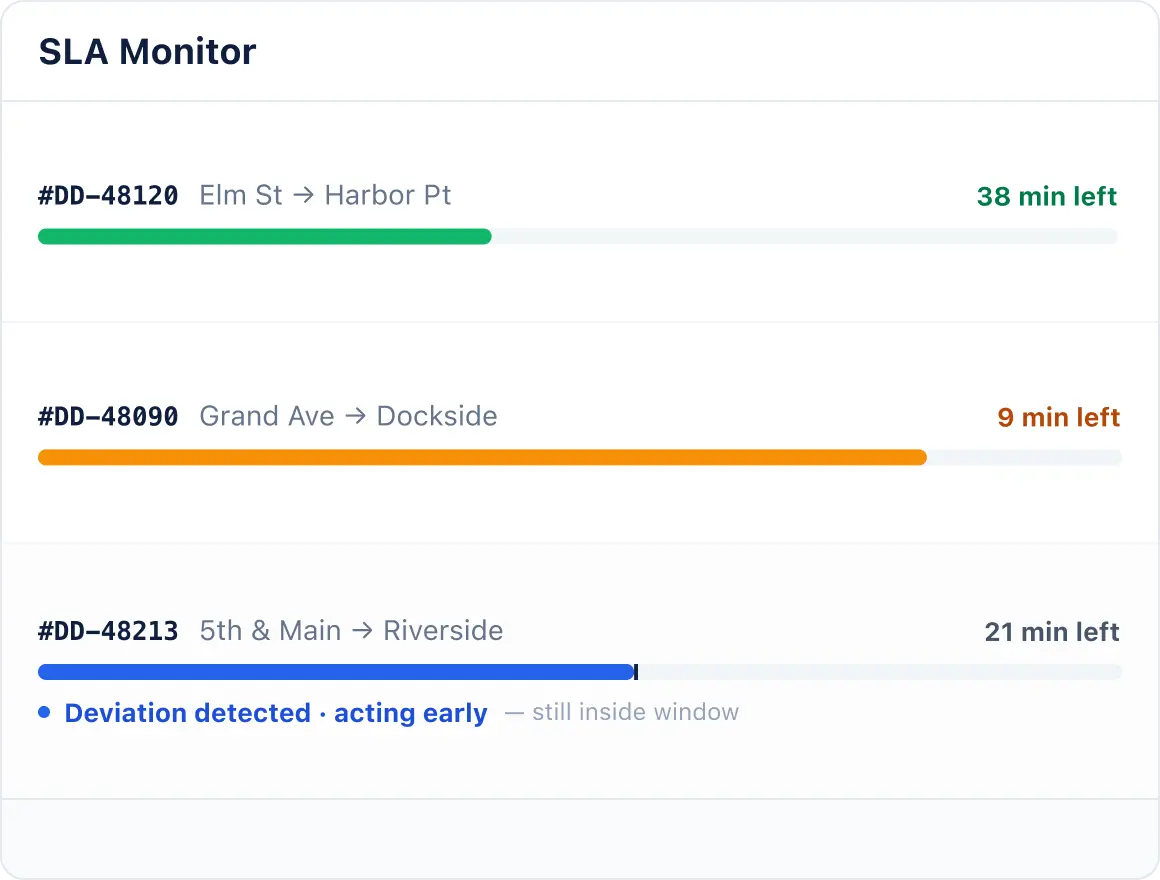
Deviations caught before the window closes.
AI engine continuously tracks active deliveries against SLA windows — geolocation, status sequence, timing — and signals the moment a deviation emerges, not after it becomes a breach.
Escalation with Context
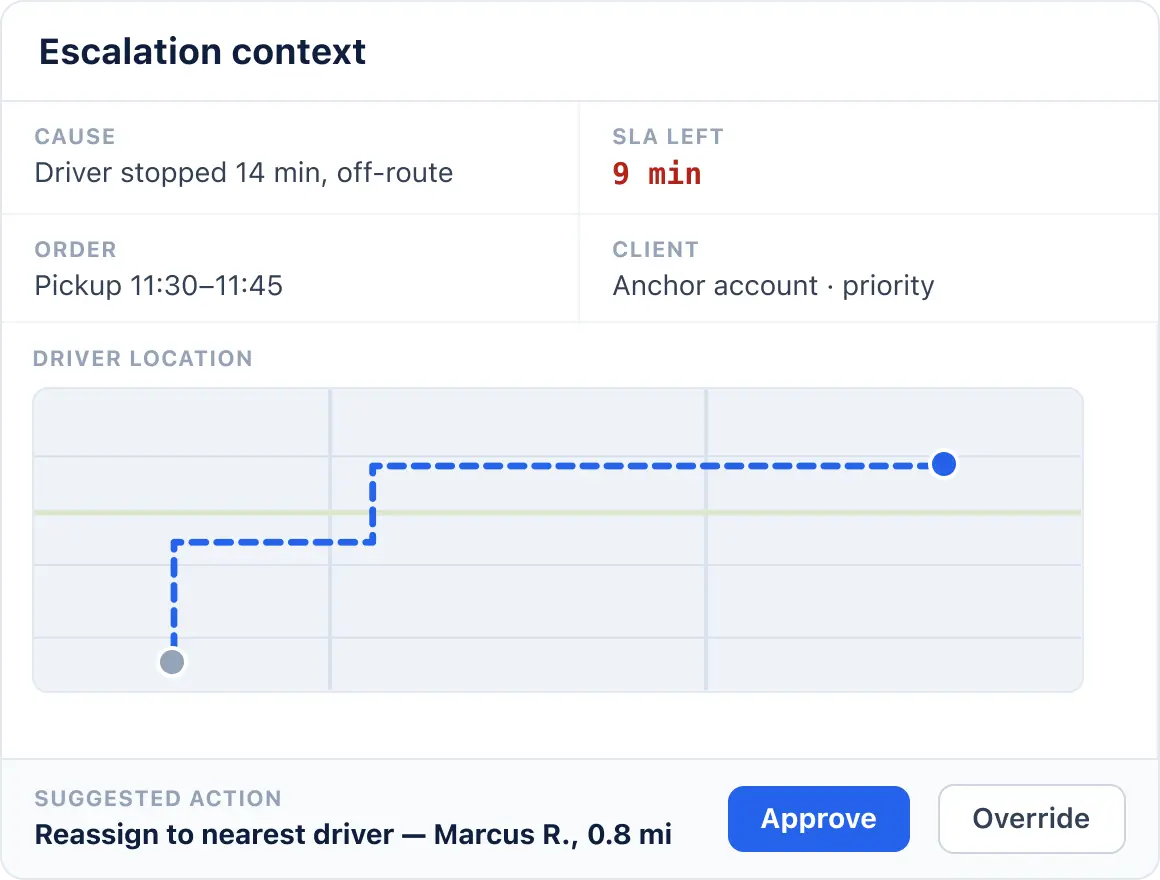
Full decision context, not just a raw alert.
When escalation is needed, the dispatcher receives the cause of the deviation, current driver location, remaining SLA time, communication history, and a suggested action.
Augmented & Autonomous Modes
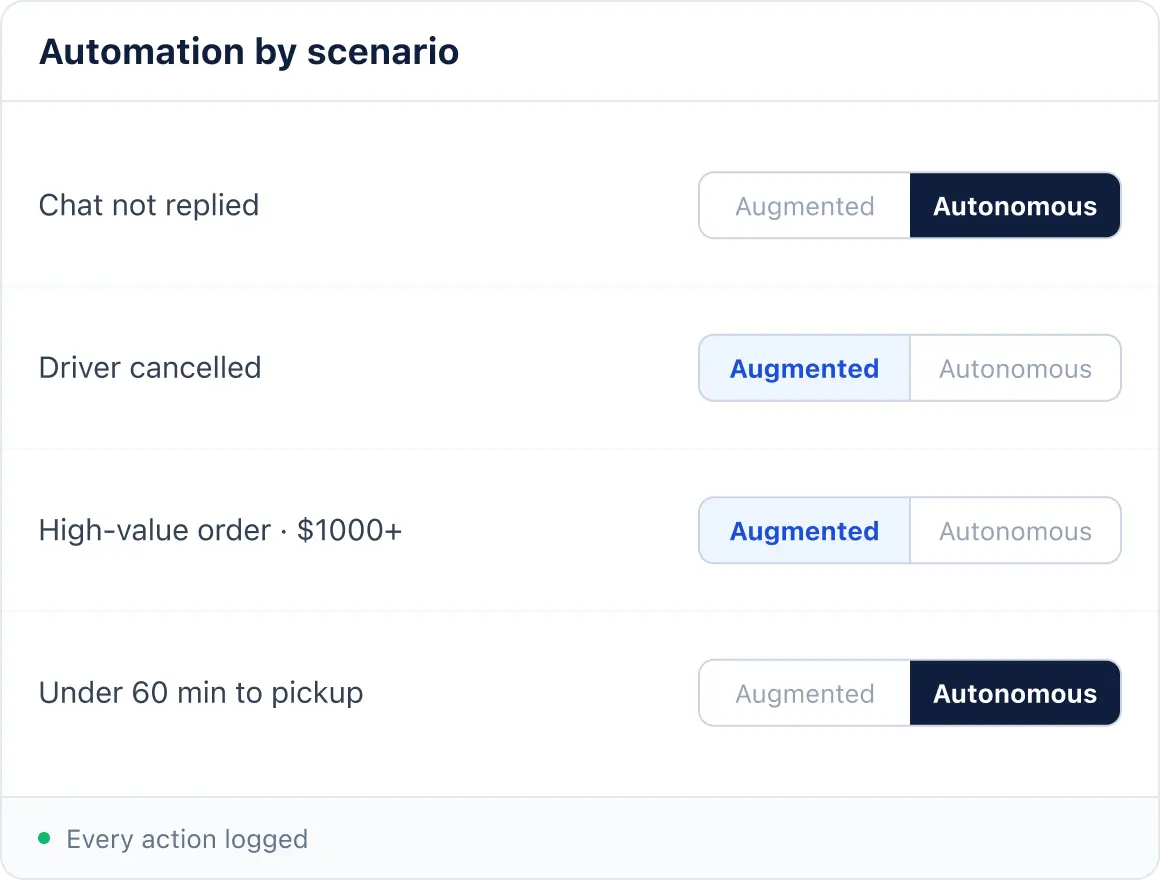
The right level of automation for every scenario.
Routine cases run autonomously with no dispatcher involved. Complex or ambiguous situations get a complete decision package prepared and waiting for approval. You choose the mode per scenario.
Exceptions your dispatchers shouldn't have to catch manually
Examples of the deviations our agents catch automatically. Many are driven by anchor clients who score your reliability and tighten terms the moment you slip.
From your existing operations to AI agents
Audit & Logic Extraction
We extract the logic from where it actually lives and hand you a map of your operations. If critical rules are buried in legacy code, we go there too — as a deeper track, not a prerequisite.
Scenario Formalization
Extracted rules are decomposed into scenarios and validated with your operations experts. Prioritization is driven by Phase 1 data, not gut feel.
Implementation
Agents are deployed inside your infrastructure and connect to your existing systems and channels. Code and all artifacts remain your business asset.
When the hidden logic becomes a system
Scale without adding headcount
Every time volume grows, the answer is another dispatcher. With Digital Dispatcher, growth becomes a configuration change, not a hiring cycle.
Predictable margin
Less manual intervention means less variance. Automated decisions and an auditable trail of every change replace volatility with stable economics.
Bus factor eliminated
Logic extracted from your key people becomes a documented, company-owned asset. A resignation is no longer an operational crisis.
Algorithmic assignment without favoritism
Manual assignment leaves room for bias and side deals. Custom AI engine assigns by algorithm and logs each manual override.
Money you didn't know you were losing
Before automating anything, the audit surfaces what internal reporting often misses: order anomalies, pricing deviations, assignment patterns.
Faster onboarding for new dispatchers
New team members work alongside a system that already knows core scenarios — time to productivity drops significantly.
Get a Bounded Pilot
Fixed scope, one measurable metric agreed upfront. You get a data-driven map of current bottlenecks and hidden losses. Artifacts stay with you regardless of the next steps.
Request a PilotBuilt for companies where dispatching is the core of the business
Vendor platform or in-house — it doesn't matter
Your platform automates the standard path. The exceptions still run through your dispatchers by hand. That manual layer sits on top of any stack, and it's what we automate.
Headcount grows every time volume does
Every new zone or anchor client triggers a new hire. Hiring is renting capacity — you need a way to scale operations that does not scale your payroll.
Your operational playbook is locked in 2 key people
Rules for client-specific handling and edge cases live only in the people who built them. When they're out, the operation slows. That knowledge should belong to the company.
Not an agent you have to train
| Criterion | Digital Dispatcher | Alternatives |
|---|---|---|
| Where logic comes from | Extracted from your operational data, chats, calls, and your people's decisions — the manual layer, whatever stack you run (code optional) | AI-workers: your team explains rules in interviews. Vendor platforms: only what fits their data model |
| Custom rule handling | Your pricing, SLA exceptions, and client-specific rules — exactly as your team runs them today | Vendor platforms cap at their own model. Can't handle what they don't see |
| System relationship | Sits on top of your existing stack — vendor or in-house. No migration, no data leaving your perimeter | SaaS-only tools cover their own layer; rip-and-replace TMS require platform migration |
| What you own | You own the extracted rules and agent code — forever | External tools: locked into vendor SaaS. In-house: bottleneck on 1–2 engineers |
| Escalation quality | Full context: deviation reason, location, SLA time remaining, communication history, suggested action | A flag — the dispatcher still has to diagnose from scratch |
Common Questions
Turn hidden dispatching logic into a documented asset
Start with a pilot and get one real metric from your operation formalized, plus a clear picture of your automation potential. You own all the insights and findings.